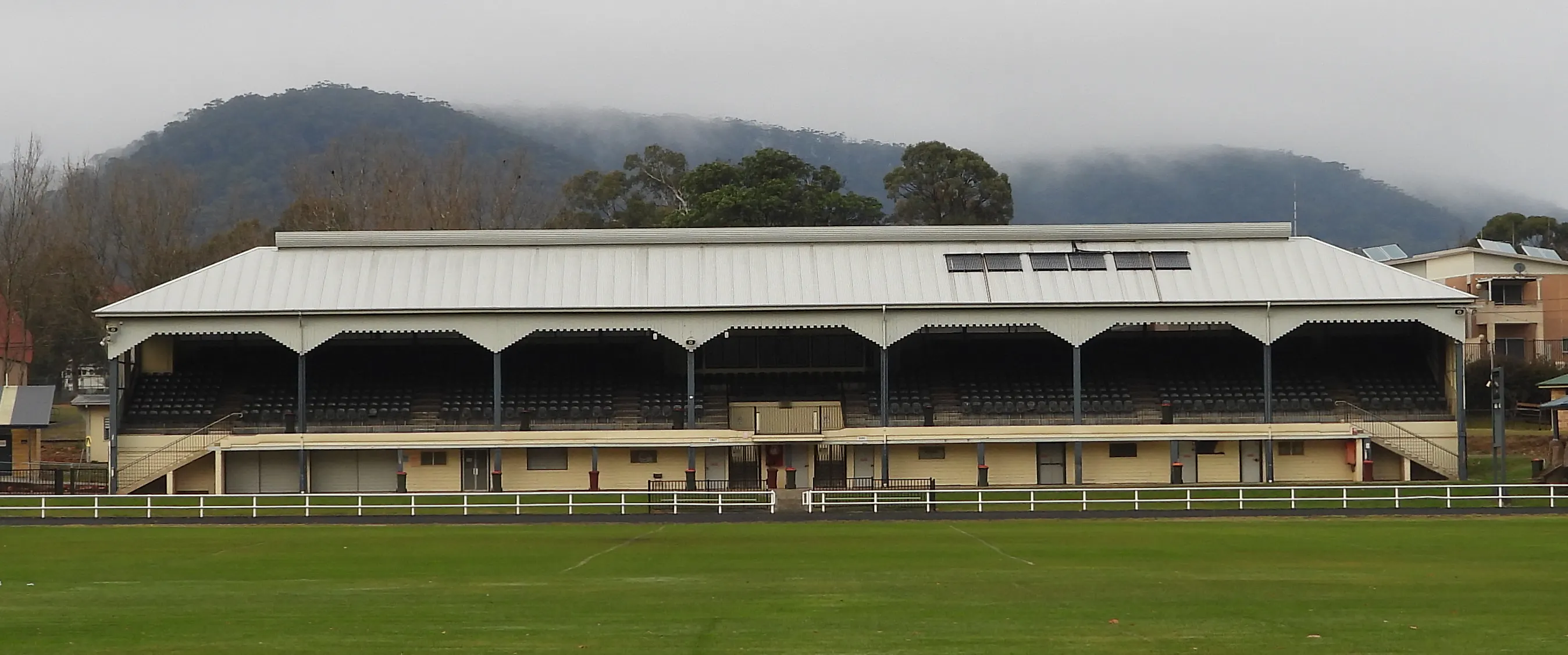
Proposal to rename Ashley Grandstand
Consultation has concluded
Proposal to rename Ashley Grandstand - Barry (Bowser) Rushworth Grandstand
At the 29 April meeting of Lithgow City Council, it was resolved to commence the process of community engagement for the renaming of the Ashley Grandstand at Tony Luchetti Showground in honor of Barry (Bowser) Rushworth.
Local sportsman and publican, Barry (Bowser) Rushworth played 104 games for Parramatta Eels between 1964-1971 scoring 25 tries (75 points). He played 2 representative games for NSW 1963-64 scoring 3 tries (9 points) and toured France and Europe with the 1964 Australian representative side playing in 1964. Scoring 1 try (3 points) in an 18-6 victory over France at the Parc des princes.
For more information on Mr Rushworth and his playing career visit Barry Rushworth - Wikipedia
Ashley Grandstand
The Heritage-listed grandstand at Tony Luchetti Showground was opened and officially named in 1937 after Senator William Patrick Ashley, a prominent local figure and former Australian Senator for NSW.
"...On his return to Australia Ashley worked in the Sydney tramways and became an official of the Tramways Union before moving to Lithgow where he entered the hairdressing and tobacconist business and was granted a billiard licence. In 1911 he was elected as an alderman to the Lithgow Council where he served almost continuously until he entered Parliament. Mayor of Lithgow in 1929 and again in 1935, he came to be described as the ‘father’ of the council. In 1937 a grandstand at the Lithgow sportsground was named after him, as was Ashley Park, Lithgow, in 1958.
It was in Lithgow that he joined the Australian Labor Party. He was Labor’s campaign manager in the district when in 1925 J. B. Chifley made his first attempt to win the federal seat of Macquarie. In 1937 Ashley was nominated by the New South Wales Labor Party (then controlled by supporters of J. T. Lang) to stand as a candidate for the Senate at the federal election of 23 October. His place at the poll, under existing electoral law, enabled him also to fill a casual vacancy, and take his place in the Senate at its next sitting. His success was due, at least in part, to Labor’s notorious ‘four A’s’ strategy under which candidates whose names began with ‘A’ were encouraged to stand in order to take advantage of alphabetical listing on the ballot paper. Thus New South Wales Labor had nominated not only Ashley but also Amour, Armstrong and Arthur. All were elected, though alphabetical listing was discontinued at the 1940 election..."
Timeline of Key Political History for Bill Ashley
This timeline highlights the main milestones in Bill Ashley’s public and political career, from local government in Lithgow to senior roles in the Australian Senate and federal ministry.
- 1911 – Elected as an alderman on Lithgow Council, beginning a long period of local government service.
- 1925 – Served as Labor’s campaign manager in the district for J. B. Chifley’s first attempt to win the federal seat of Macquarie.
- 1929 – Served as Mayor of Lithgow for the first time.
- 1935 – Served a second term as Mayor of Lithgow.
- 23 October 1937 – Elected to the Australian Senate for New South Wales as an Australian Labor Party candidate.
- 30 November 1937 – Took his seat in the Senate.
- 1938–1941 – Served as Opposition Whip in the Senate.
- October 1941 – Appointed Postmaster-General and Minister for Information in the first Curtin Government.
- 1942 – Sponsored the Australian Broadcasting Bill, supporting the independence and development of Australian broadcasting during wartime.
- September 1943 – Left the Information portfolio; became Vice-President of the Executive Council and Deputy Leader of the Government in the Senate.
- February 1945 – Appointed Minister for Supply and Shipping.
- 1945 – Joined the Production Executive of Cabinet.
- June 1946 – Became Leader of the Government in the Senate.
- April 1948 – Appointed Minister for Shipping and Fuel, overseeing shipping, coal, and fuel policy.
- 1948 – Played a major role in legislation re-establishing the government shipping line.
- 1949 – Was central to government negotiations during major coal and industrial disputes; introduced the Liquid Fuel (Rationing) Bill.
- December 1949 – After Labor’s election defeat, became Leader of the Opposition in the Senate.
- 1951 – Lost the Senate leadership following the double dissolution election.
- 1955 – Re-elected to the Senate at the top of the poll in New South Wales during the Labor split era.
- 27 June 1958 – Died in office as Senator for New South Wales.
For more information on Senator Ashley visit The Biographical Dictionary of the Australian Senate online - William Patrick Ashley (1881-1958)
How will Senator Ashley continue to be recognised if the name is changed?
The council wishes to encourage everyone to provide feedback on the proposal to rename Ashley Grandstand, the 'Barry (Bowser) Rushworth’ Grandstand. All feedback will be considered by Council at the June Council meeting. Should the Council resolve to rename the Ashley Grandstand, The Barry (Bowser) Rushworth Grandstand, then commemorative plaques, detailing Senator William Ashley's and Mr Rushworth's achievements and legacy will be placed at the Grandstand.
How do I make a submission?
Feedback opens on Tuesday 26 May and closes on Monday 22 June.
The simplest way to make a submission is to answer our Quick Poll "Do you support the renaming of Ashley Grandstand to Barry (Bowser) Rushworth Grandstand?" by clicking the in the side panel
If you wish to provide additional information to support your response you can do so by completing our Submission form below.